
The line is two pings and a wind direction
A start line is two points. You record them by sailing to each end and pressing a button, and from that moment the line is a segment between two latitude and longitude pairs. Everything the report says about it is geometry on that segment, worked in metres on a flat plane — a degree of latitude is the same length everywhere, and a degree of longitude shrinks by the cosine of the latitude, taken at the mean latitude of the two ends.
Distance to the line is the perpendicular distance to the infinite line through both ends: not the distance to the nearer end, and not to the midpoint. It comes out of a cross product, which returns a signed number — so which side of the line you are on is already contained in the answer. A raw cross product only knows left and right, and left and right depend on which end you happened to ping first, so the wind decides: the platform checks which side the upwind direction points toward and orients the sign so positive is the pre-start side and negative is over.
Line bias comes off the same two vectors: project pin-to-committee onto the upwind direction and you have how much further upwind one end is, in metres. Degrees are the sailing unit because they are comparable between a 100-metre dinghy line and a 400-metre grand-prix one, so the report states the arcsine of that ratio over the line’s length. Inside a metre either way the line is called square rather than flickering between two answers: a ping is a GPS fix taken from a moving boat, and a metre is comfortably inside its uncertainty.
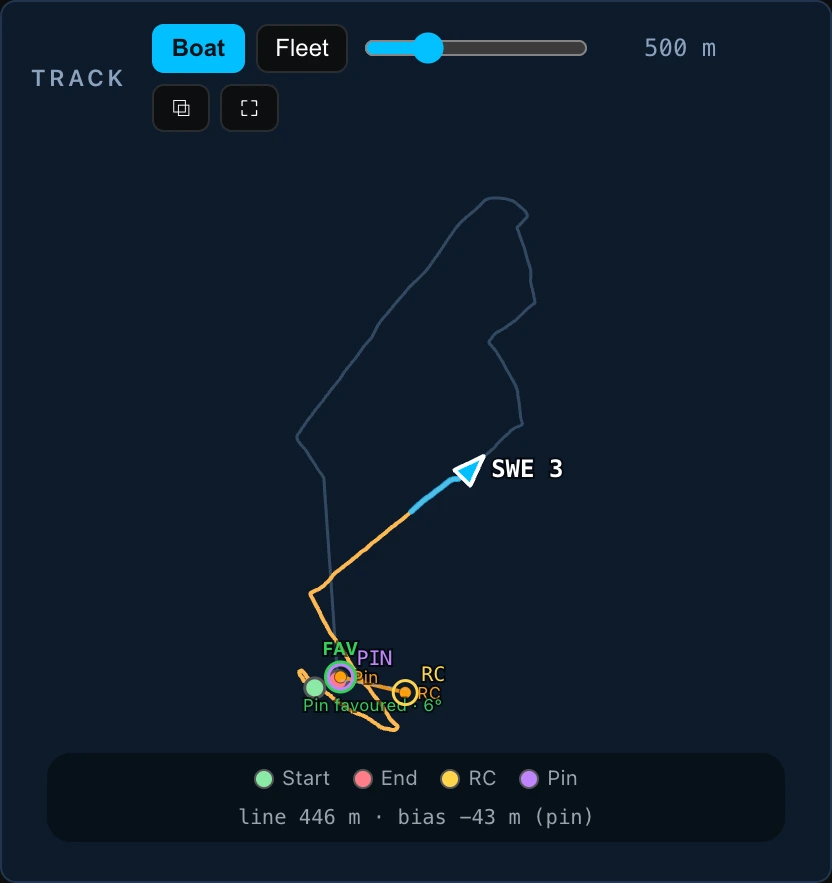
Ends get re-pinged: the committee boat drags, the race officer moves the pin, somebody pings the wrong end and does it again. So for any moment being asked about, each end independently uses the most recent ping at or before that moment. Pings after it are not consulted, which is what lets the debrief replay a start against the line as it stood at the gun rather than against the line as it was eventually corrected.
What the gun measures
Every race with a gun offers a report of its start, opened from the race in the report library or from a button on the debrief player while you are watching that race. The headline compares this start with the day’s others: boat speed and progress at the gun, how far from the line you were, how long the crossing took, and how long it took to reach ninety-five per cent of target speed and of best progress.
The target those last two are measured against is the boat’s own polar, read at the wind of the moment — the same yardstick the rest of the debrief uses. The last three minutes are drawn over the ground with the line on them, coloured by boat speed against that target, so a slow approach and a slow first minute are the same colour on one picture. Under it, a table runs second by second from 1:20 before the gun: distance behind the line, wind angle against target, boat speed, progress, wind direction, the recorded burn and the rudder, with the second you crossed emphasised.
Recorded, or computed — and the report says which
Two rules govern what is drawn, and both follow from the geometry rather than adding to it. The line is the one that was pinged: the report draws the recorded pin and committee positions and the line between them, and a line re-pinged after the gun is not applied backwards to a start sailed against the old one. And the distance behind the line at the gun is the recorded one, read from the gun event as it was logged rather than recomputed from positions.
The two would agree to a tenth of a metre — the geometry runs on the tablet during the sequence and again in the debrief, and both implementations are tested against one shared set of cases — but the recorded value is the number the crew saw, and that is the one worth printing.
Only the numbers nobody recorded are computed afterwards, and the report names which those are. A race with no line ping and no recorded distance gets neither: the report says so in a line of its own rather than drawing a line nobody laid, and the plan view still draws the track, because the boat was there.
A race nobody typed in
The report needs a race to be about, and nobody enters one. A day arrives as a continuous stream from dock-out to dock-in, and the races inside it are derived from the signals: guns, warning signals, general recalls and the navigator’s finish press.
Guns are collapsed first, because the same start is often recorded twice — the navigation software logged it and so did the tablet, thirty seconds apart. A gun is kept only if it is at least 120 seconds after the last kept one. Each kept gun then takes the latest warning in the ten minutes before it as the race’s start, or failing that the gun minus ten minutes, because the pre-start is most of what a start is worth reviewing.
A warning with no gun in the ten minutes after it gets one invented, at the warning plus five minutes. That is not a curiosity: it is the tablet whose battery died during the countdown, and losing the race because one event went missing would be the wrong answer. A general recall works the other way and is handled first, reaching backwards at most ten minutes to void the gun it followed and any warning that would otherwise re-derive the start that died.
A start report is offered for a race with a gun, and the gun may be a derived one. What the report cannot tell you is whether you were on the course side: that is the race committee’s to decide, and nothing here is evidence in a protest.
The report, and the instrument beside it
A report is a document — paged, printable, and reproducible from a yardstick stated on its own last sheet. It carries no scrubber and no hover read-out. Exploring the same minutes second by second is what the debrief player is for: the gun, the warning and each line ping are marks along its scrubber, and clicking one lands the cursor exactly on it.
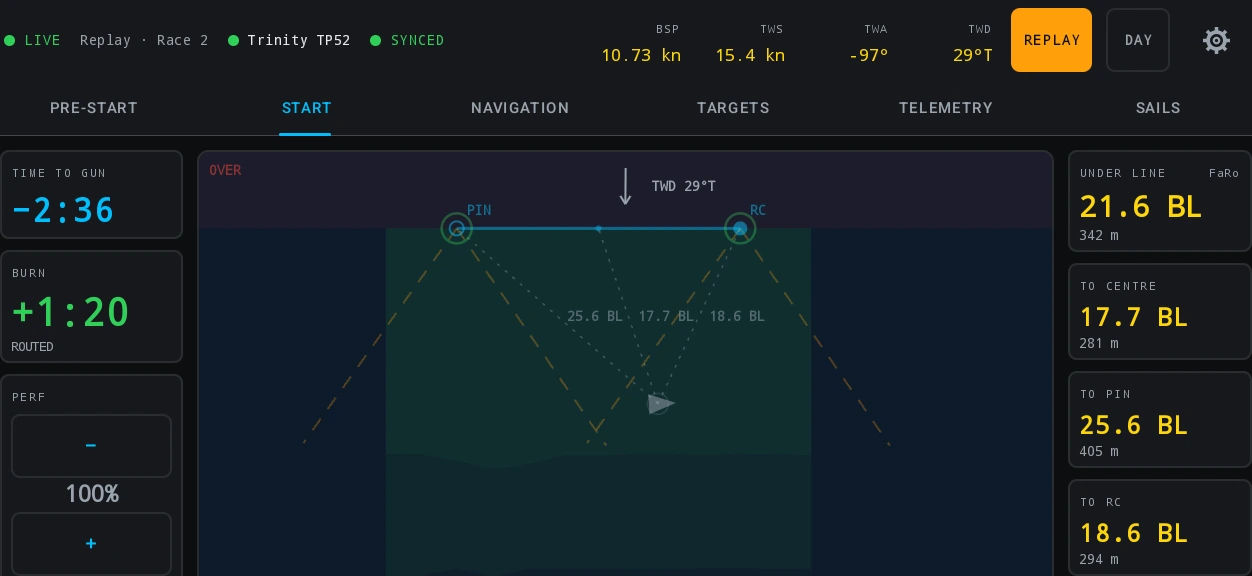
Where Race Control was running for the start, the player also replays the TIME TO LINE card the crew were looking at, in step with the playback cursor. It is a recording of that screen rather than a re-calculation, which is why a row reading a dash stays a dash: the tablet had no answer at that moment and showed the crew the same dash, and inventing a number over it would replay a start that never happened.
Read the method
The documentation this post draws on.
- The start line — The geometry both the tablet and the debrief run: distance to the line, line bias in degrees, the favoured end, and what makes a boat over early.
- How a race derives itself — Turning a day of guns, warnings, recalls and one finish press into races, days and regattas — with every window named.
- Performance reports — Opening a sailing day as a report: the modes and groupings, the manoeuvres, start and race-legs reports, what every layer of a figure is, what a missing figure says, reading a chart as a table, printing to A4 and exporting a PDF.
- The debrief player — Opening a race and reading it: the timeline and its event marks, transport and keyboard, the Explorer, the tuning guide, the HUD and deep links.