
Two pings and a line
Everything on the pre-start screen comes out of four inputs: two pinged ends, a position and a wind direction. Sail to each end of the line and press its button — PIN and RC, one tap each. The position is taken from the boat’s own instruments at the moment of the press rather than from the tablet, and a press with no fresh fix behind it is refused and says so.
Once both ends are in, the buttons lock. The toggle above them allows exactly one ping and re-locks the moment either end is taken, which is what stops a bag on the pedestal re-pinging the line at T−30. Re-ping freely when the committee moves an end: each end independently uses the most recent ping at or before the moment being asked about, so the debrief still replays the start against the line as it stood at the gun. A ping over ten minutes old goes amber, because the committee may still have been laying the line when it was taken.
The LINE card then carries three numbers. DIST is the perpendicular distance from the bow to the line, with the boat’s own length under it in lengths and a badge saying where it came from — pings when it is computed from the fix and the two ends, FaRo when the boat’s own processor publishes it. LENGTH is the distance between the two pings. BIAS is how far the line is off square to the true wind, in degrees, and which end that favours; inside a metre either way the card says the line is square rather than flickering between two answers on GPS noise. Being over is not a separate calculation — it is the sign of the distance already on screen, which is why the two can never disagree.
Why one number was never enough
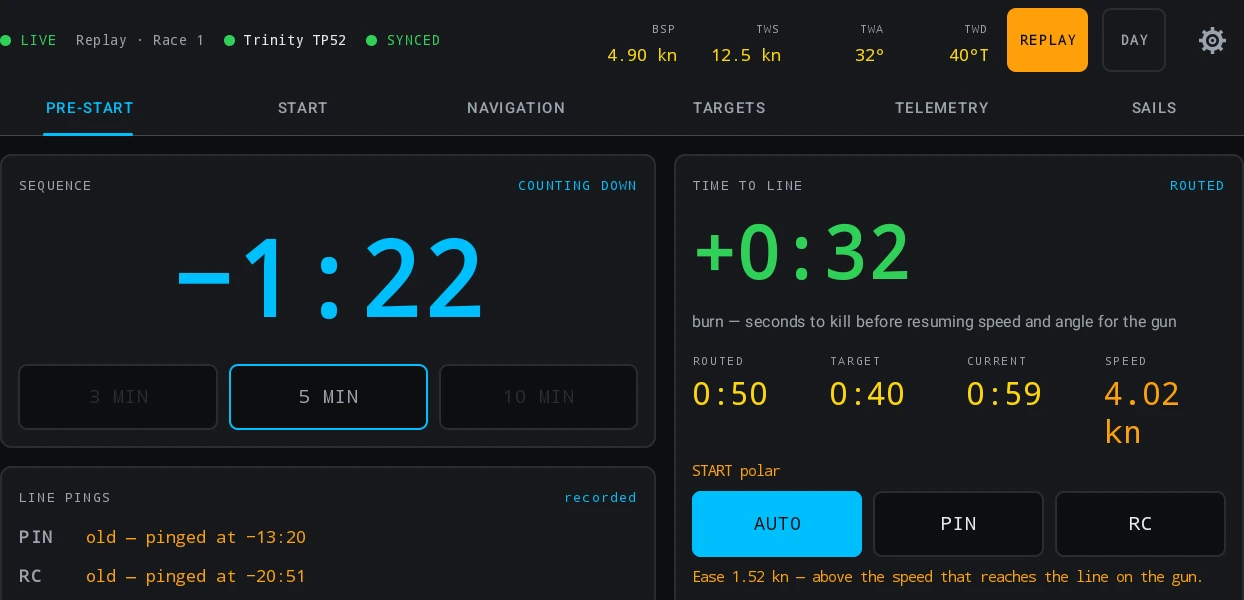
Distance divided by boat speed is the first answer anybody writes down, and it assumes three things at once: that the boat is pointed at the line, that it is doing the speed it could be doing, and that it is on the course it is going to start on. The card relaxes those assumptions one at a time, which is what produces four cells rather than one.
| Cell | Computed from |
|---|---|
| CURRENT | The speed the boat is doing, on the course it is doing — and only the part of that speed aimed square at the line counts, so a boat reaching along a line is closing it at nothing. |
| TARGET | The same course and the same geometry, with the measured speed replaced by target speed from the start polar at the live wind. |
| ROUTED | The fastest sailable route to the line — one leg or two, with your own tack and gybe costs charged to it, and a turning point that has to stay on the pre-start side. |
| SPEED | The same geometry solved for the other unknown, in knots: the most boat speed you can carry on this course and still not be early. |
Because the three time tiers differ only in what they assume, the gaps between them are measurements rather than disagreement. CURRENT minus TARGET is the speed you have not found yet — trim on and the first walks down to meet the second. TARGET minus ROUTED is the angle and the manoeuvring you have not made yet. Settled on the course you are starting on, at target speed, with no turn left to make, the three collapse onto one number.
A tier that cannot answer returns nothing rather than quietly falling back to the tier below wearing its name: no polar or no wind speed means no TARGET and no ROUTED, and the badge on the card says which tier is talking.
The burn on top
The large number is the one a crew sails to.
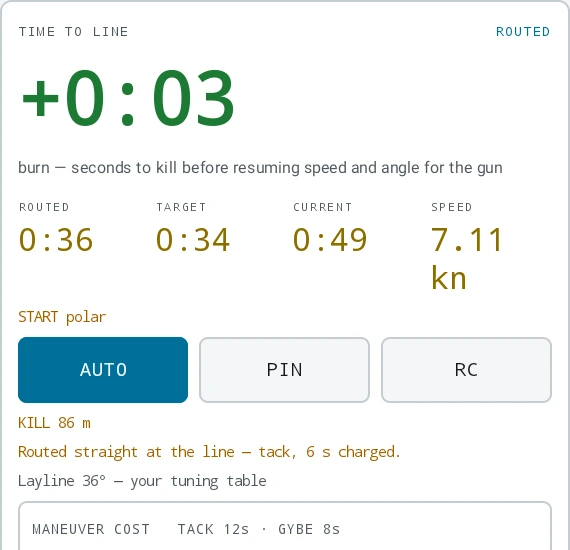
Positive means you will arrive early and have seconds to kill; negative means you are late for the gun. The card prints it as “seconds to kill before resuming speed and angle for the gun”, which is the manoeuvre it is asking for.
It rounds pessimistically in both directions — spare time down, lateness up — so six and a half seconds early reads +0:06 and six and a half seconds late reads −0:07. A number that flatters the boat is the one number a start instrument must not print.
AIM, PERF and KILL
AIM is AUTO, PIN or RC. On AUTO the routing picks the end it can reach soonest; choosing one points every tier, the burn and SPEED at that end for the whole approach. The soonest-reachable end of a biased line is the unfavoured one, because it costs the least upwind gain — so this is a clock rather than advice about where to start, and the LINE card goes on naming the favoured end while you aim at the other one. A crew overriding a recommendation is owed the recommendation.
PERF trims the model to the day, between 80 and 120 %. It scales the target and routed tiers and nothing else: CURRENT is a measurement and PERF never touches it. A boat not quite on its numbers is the ordinary case rather than a fault to be argued with.
KILL is the water it takes to stop the boat from its current speed, read off the boat’s own braking table and shown in metres while a sequence is armed. It is an advisory and never enters the burn arithmetic — the burn answers in seconds, and a helm coming into a crowded line needs the answer in metres.
The same minutes as one picture
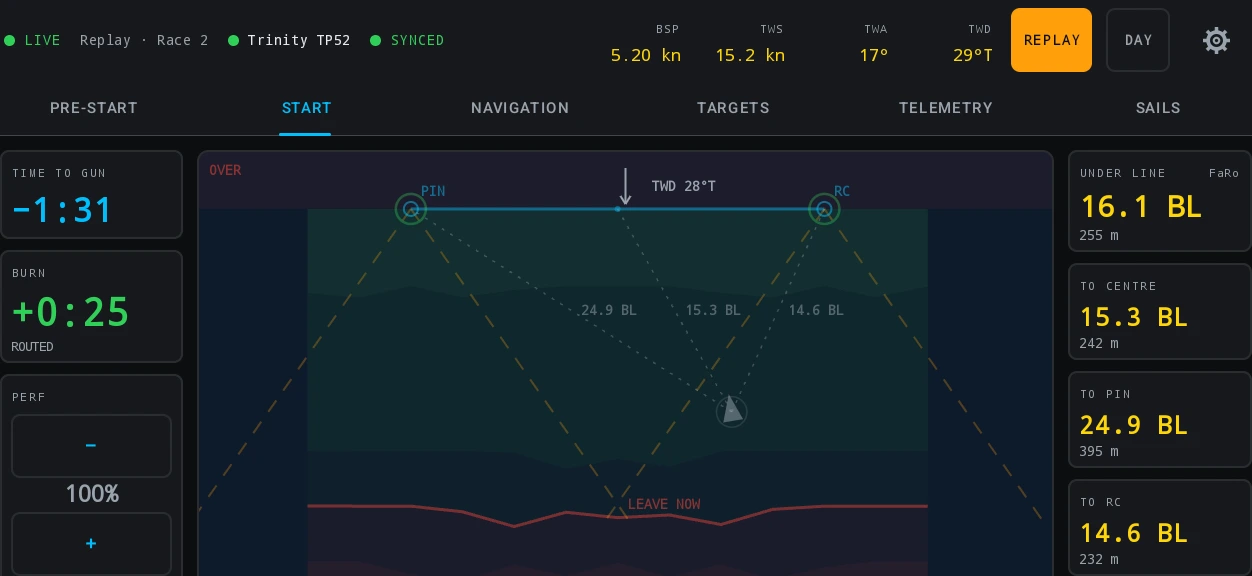
START is the other half of the arrangement. It carries the same last minutes as one full-screen view — time to gun, the burn, how far under the line the bow is, PERF with a step either side, and the line itself with the laylines off both ends and the distances to the pin, the committee boat and the point square to the boat. One person can work PRE-START while the helm sails off START.
None of this is a ruling. Whether a boat was on the course side at the start is the race committee’s to decide, and nothing here is evidence in a protest. The routed tier also assumes clean execution: it charges your manoeuvre cost and then times every leg at polar speed, and it knows nothing about waves, traffic or the boat to leeward of you.
The geometry behind all of it runs twice — on the tablet during the sequence and in the debrief when you replay the start — and both implementations are tested against one shared set of cases, agreeing to within a tenth of a metre and a tenth of a degree. The distance you were shouting from the rail at T−30 is the distance the debrief shows you that evening.
Read the method
The documentation this post draws on.
- The start line — The geometry both the tablet and the debrief run: distance to the line, line bias in degrees, the favoured end, and what makes a boat over early.
- Time to the line — The pre-start card’s four answers: three tiers of time to the line, the speed that puts you there on the gun, and what the gaps between them are telling you.
- Running a windward/leeward race day — A day whose course arrives over the radio, in order: the polar roles, targets, sails and instrument mapping to set up first, the tablet at the dock, pinging the line and reading the approach, the course laid from one radio call, laylines and board times, the second and third races, FINISH — and what is in the debrief afterwards.